Types of Monkeys
Types of monkeys are classified into two major groups, the New World primates (South and Central America) and the Old World primates (Asia and Africa). The major difference, besides living on different continents, is that the New World primates have tails that can grasp and hold things while the Old World primates can't do much with their tails and sometimes have no tail at all. New World primates do not have versatile opposable thumbs like many other primates and most Old World primates do.
New World Monkeys
Pygmy Marmoset - The Smallest Monkey
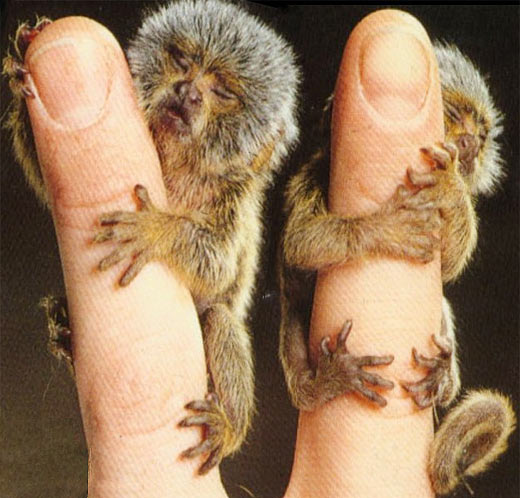 These are the smallest monkeys in the world although there are some primates that are bit smaller (pygmy mouse lemurs and pygmy tarsiers). The body weight of adults in the wild averages only 4 ounces! You can see from the picture above why they are often called "finger monkeys." They are about 5 inches (13cm) tall, not including the tail. Which means they might be hard to observe in the wild as they tiny enough to be high-up in the trees on small branches. Up there, they have to be on the lookout for birds of prey. They are able to jump more than 16 ft or 5 m! Quite a distance for such a small monkey.
Squirrel Monkeys are some of the most common monkeys in South and Central American rainforests. They have a very large range throughout the Amazon and otherrainforests. They live in groups of 10-70 but have been seen in groups as large as 100-300 individuals. The groups are split up into adult male bands, groups of mothers with their young, and juvenile bands. Mothers with their young seem to form the core of their society but neither males or females try to dominate. Adult males come around to intermingle with the females during the several months of year that mating occurs.
Squirrel Monkeys
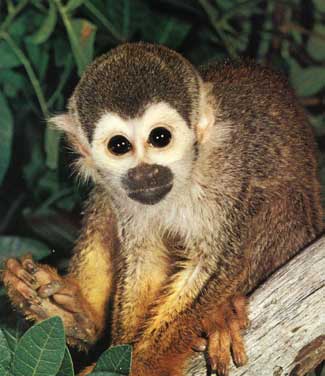 Squirrel monkeys are shy, non-aggressive and silent but make little squeaks and peeps at times and may shriek if they are in danger. They generally stay in the tree canopies but may occasionally come down to the ground to look for food. They have long tails which they use for support and balance as they are agile climbers andleapers. They also have hairy ears
 Spider Monkeys - Jungle Acrobats, High Swingers
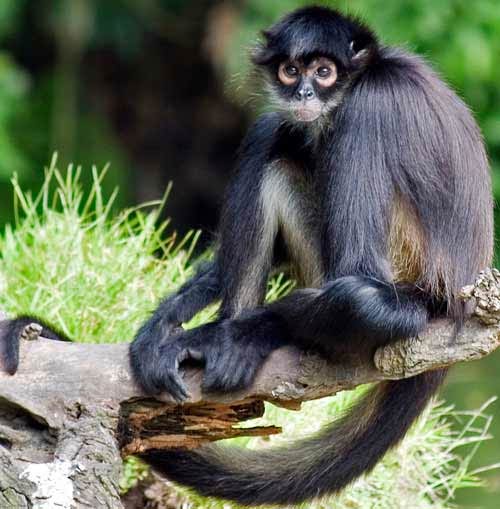
The spider monkey is just that - spidery. Mostly dark brown and black all over they have long tails, spindly legs, little pot bellies, little heads, long hands and bare faces. They make their way through the jungle swinging acrobatically with their gangly long arms.
Saki Monkey - Thick, Long-Coated Fuzzy Face
 Saki Monkey is a more common name for any primate that is a member of the Pithecia genus. There are 8 saki species in this group and there are also 5 in another genus - Chiropotes or “bearded sakis”. They live all across South America from South Colombia to Central Brazil. They are arboreal and live in the trees of rainforest regions.The monkeys are smallish in size and have impressively long bushy tails. They have especially strong hind legs so they can make the huge leaps needed when moving from tree to tree. They can reach up to 20 inches (50 cm) and 4.4 lbs (2 kg) in weight. They have rough furry skin which can be black, grey or reddish depending on the particularly species. This face is often naked with no fur at all but they do all have afurry hood around their faces. The Guianan saki the males and females have vastly different appearances, the male is all black shaggy, long fur with a pale, yellow-orange face and black nose while the female is gray-brown with white-tipped hairs and white stripes on the sides of her nose. The black bearded saki is also of notable appearance with a long reddish-brown coat and what looks like a neatly trimmed, long beard of anImam.They live up to thirty years and their young are fully mature at about three years old. They mate whenever they feel like it and there is no specific mating period. The gestational period is approximately 150-170 days and they give birth to a single offspring.
Golden Lion Tamarin - The Lion Monkey
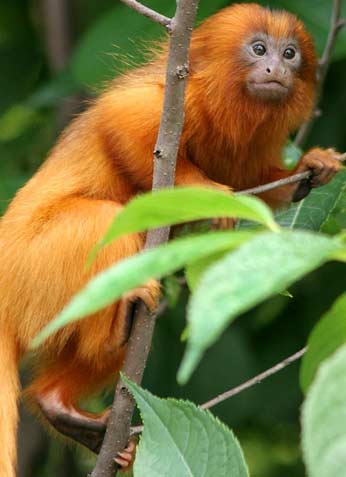 The golden lion tamarin or lion monkey, a native of Brazil, is one of the most brilliantly colored animals of all the mammals. The little fireball monkey has a big gold-orange-yellow ruff or mane of long hair around its face and neck covering its ears. Some of them are a very light golden color, others are rather bright orange and still others have some dark brown coloration as well. The hands, feet and face however are a dark brown or purple-ish color. It is a small-medium sized monkey averaging about 8 inches (20 cm) tall with a tail about that long also.The golden lion tamarin or lion monkey, a native of Brazil, is one of the most brilliantly colored animals of all the mammals. The little fireball monkey has a big gold-orange-yellow ruff or mane of long hair around its face and neck covering its ears. Some of them are a very light golden color, others are rather bright orange and still others have some dark brown coloration as well. The hands, feet and face however are a dark brown or purple-ish color. It is a small-medium sized monkey averaging about 8 inches (20 cm) tall with a tail about that long also.it is an endangered species as there may only be 1000 or less individuals left in the wild. It lives in a small region in the Southeastern part of Brazil near the coast. Maybe that is why they appear sad in some of the photos but we are rooting for them to re-populate!
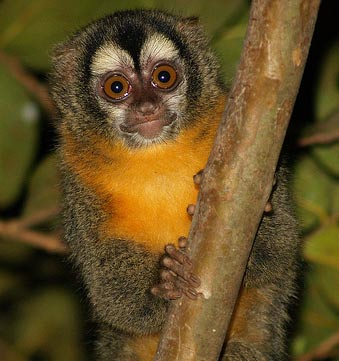
The owl monkeys are rain forest monkeys that have a bit of an owlish face that always seems to be smiling. They have many different vocalizations, up to 50 or more, including a piercing alarm shriek. They are night eaters, usually in pairs, they go browsing and foraging, eating fruit, leaves, and insects in the dark forest. In the daytime they sleep together in small family groups within hallowed-out trees.
Howler Monkeys - Jungle Noisemakers - World's Loudest Animal

Howler monkeys define the jungles of the Americas with their ruckus. Without their throaty howl it wouldn’t be the same. As the sun rises, the howlers inflate their throat sacs like great wind instruments and bellow a haunting, deafening call that can carry for miles (as many as 10). They are perhaps the loudest animals on land. Howling is mostly an activity for the males but the females vocalize a little too.Then when they finish with their morning howl they start foraging for breakfast. They chew and climb slowly, taking days to cover the square kilometer expanse of a group’s range. A male, female, their young, and the whole clan will slowly move along in the upper jungle branches. They crawl along, not leaping and swinging like spider monkeys, and tend to use their favorite paths over and over. They almost always have a good grip on things with their long prehensile tails. They can spend long hours gazing into the jungle. Apparently, their diet of fruit and leaves is not very energizing for these big monkeys and they can sleep as much as 15 hours in a day. They are the largest monkeys in the Americas.
 Snub-nosed Monkeys aka "Sneezing" or "Michael Jackson" Monkeys

Most closely related to colobus, doucs and other leaf monkeys are a group of monkeys known for their stubby snouts – the snub-nosed monkeys, sometimes also called langurs. They really have no snout at all, just some holes where a nose might be and if a raindrop falls right in there the monkey has to sneeze. They live all over Southern China and into Tibet, Vietnam and Myanmar. There are several different species colored in various ways. Sometimes they are called by their colors, other times by the region they come from and other times by the name of their discoverers. There are the Golden (including the Moupin, Qinling and Hubei subspecies), the Black (aka Biet’s, akaYunnan), the Gray (aka Brelich’s), the Tonkin and the Myanmar (recently discovered) species. And there is also the more distantly related Pig-tailed snub-nosed of the Mentawi Islands, Indonesia.
 What a monkey the mandrill is! Not only is it the world's largest species of monkey, with males occasionally weighing as much as 110 lbs (50 kg) and standing up to 3 ft (90 cm) tall; it's also the most colorful monkey there is. In fact, Charles Darwin once said of this large baboon, “no other member in the whole class of mammals is colored in so extraordinary a manner as the adult male mandrills”. With it's olive green or dark gray coat with yellow and black bands, a white belly, a hairless face, red nostrils and lips, a yellow beard with white tufts, an elongated muzzle with it's own distinctive characteristics (a red stripe down the middle and protruding blue ridges on the sides) and a lower body that can be red, pink, blue, scarlet, and purple, the mandrill is a sight to see! The female is not so massive and scary, she looks small in comparison to the male and is not so brightly colored.What a monkey the mandrill is! Not only is it the world's largest species of monkey, with males occasionally weighing as much as 110 lbs (50 kg) and standing up to 3 ft (90 cm) tall; it's also the most colorful monkey there is. In fact, Charles Darwin once said of this large baboon, “no other member in the whole class of mammals is colored in so extraordinary a manner as the adult male mandrills”. With it's olive green or dark gray coat with yellow and black bands, a white belly, a hairless face, red nostrils and lips, a yellow beard with white tufts, an elongated muzzle with it's own distinctive characteristics (a red stripe down the middle and protruding blue ridges on the sides) and a lower body that can be red, pink, blue, scarlet, and purple, the mandrill is a sight to see! The female is not so massive and scary, she looks small in comparison to the male and is not so brightly colored.The male will leave it's natal group at around six years of age, and will spend the rest of it's long life (in captivity they have been seen living up to 31 years) on the peripheralof the horde, only entering the main group to mate. Mandrills use grunts and teethbaring to communicate over both short, and long distances. They are considered a “vulnerable” species, and are in danger of becoming extinct if their natural habitat continues to be destroyed.
Mandrill - The Largest and Most Colorful of All Monkeys
 What a monkey the mandrill is! Not only is it the world's largest species of monkey, with males occasionally weighing as much as 110 lbs (50 kg) and standing up to 3 ft (90 cm) tall; it's also the most colorful monkey there is. In fact, Charles Darwin once said of this large baboon, “no other member in the whole class of mammals is colored in so extraordinary a manner as the adult male mandrills”. With it's olive green or dark gray coat with yellow and black bands, a white belly, a hairless face, red nostrils and lips, a yellow beard with white tufts, an elongated muzzle with it's own distinctive characteristics (a red stripe down the middle and protruding blue ridges on the sides) and a lower body that can be red, pink, blue, scarlet, and purple, the mandrill is a sight to see! The female is not so massive and scary, she looks small in comparison to the male and is not so brightly colored.What a monkey the mandrill is! Not only is it the world's largest species of monkey, with males occasionally weighing as much as 110 lbs (50 kg) and standing up to 3 ft (90 cm) tall; it's also the most colorful monkey there is. In fact, Charles Darwin once said of this large baboon, “no other member in the whole class of mammals is colored in so extraordinary a manner as the adult male mandrills”. With it's olive green or dark gray coat with yellow and black bands, a white belly, a hairless face, red nostrils and lips, a yellow beard with white tufts, an elongated muzzle with it's own distinctive characteristics (a red stripe down the middle and protruding blue ridges on the sides) and a lower body that can be red, pink, blue, scarlet, and purple, the mandrill is a sight to see! The female is not so massive and scary, she looks small in comparison to the male and is not so brightly colored.The male will leave it's natal group at around six years of age, and will spend the rest of it's long life (in captivity they have been seen living up to 31 years) on the peripheralof the horde, only entering the main group to mate. Mandrills use grunts and teethbaring to communicate over both short, and long distances. They are considered a “vulnerable” species, and are in danger of becoming extinct if their natural habitat continues to be destroyed.


