Saturday, 6 April 2013


World's Smallest Vertebrate Discovered

smallest vertebrateThe tiniest frog and the tiniest vertebrate that currently exist on the planet Earth was discovered recently in a rainforest on the island of Papua New Guinea. Before the discovery of this frog, a tiny transparent fish from Indonesia was the world record holder for tiniest vertebrate at eight milimeters long. The frog however, is slightly smaller than that, measuring only 7.7 millimeters (average species size for adults). The tiny size of the the frog, its habits and its habitat all contribute to why it wasn't found before.
The frog, which currently has no common name except for "the tiniest frog from Papua New Guinea", has the scientific name of Paedophryne amauensis. It sounds like an insect with the high-pitched mating call it makes. It is dark brown with black patches and blue-white dots. It can jump 30 times the length of its body.

Thursday, 4 April 2013


Aye-aye

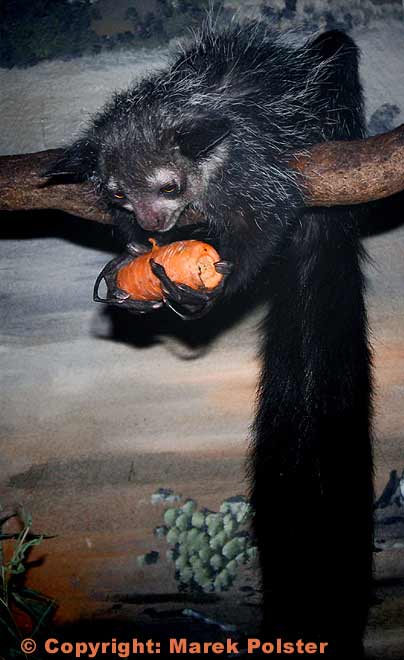
aye-aye and tailWhat could this beast be? It is from Madagascar. It has long shaggy dark fur with long white hairs. It has the face of Nosferatu. It was first thought to be a rodent. It is the Aye-aye. It is of course nocturnal and has a long bushy tail and big ears. Poor creature, the native people of Madagascar long considered it an omen of bad luck and tried to kill it on sight and it is now considered a "near threatened" species. The Aye-aye builds nests in several locations with twigs and leaves to sleep and keep their young. They have very long middle fingers which they use to reach into the holes in trees to extract tasty insects. The also tap tap tap with their fingers on the trees and then listen to see if they have stirred any grubs or tasty creatures to eat. They enjoy grooming and sitting still meditating for as long as 2 hours.
  aye-aye face

Wednesday, 3 April 2013


Pink Amazon River Dolphin

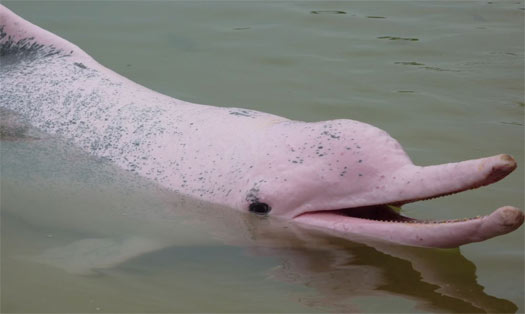
amazon river dolphin say hello

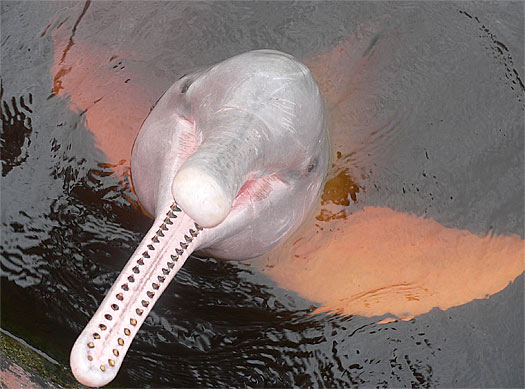
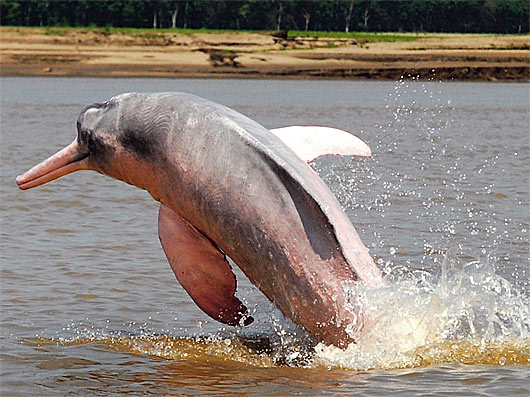
The pink or Amazon river dolphin is a rare species of aquatic mammal, obviously characterized by its pink skin. They are between 8.25 ft (2.5 m) and 9.75 ft (3 m) long and usually weigh around 200 lbs (90 kg). They have long beaks and tiny eyes. Vision is limited in the muddy waters of the rivers and they probably rely more onecholocation (sonar). Instead of a dorsal fin, this species has more of a simple ridge on their backs. As with many species the male is usually larger than the female.
amazon river dolphin leaping 

The pink river dolphin is usually found in the tributaries and main river flow of the Orinoco and the Amazon in South America. The reason for the characteristically pink skin is not thoroughly understood. Some scientists believe that the presence of capillaries near to their skin gives them the pinkish tone that they’re known for. Other factors which could contribute include the animal’s age, temperature of the waters and even the chemical make-up of the waters especially in relation to the iron levels. Individuals have varying shades of color, with some being mostly light gray, and some mottled with gray and pink patches or spots.

amazon river dolphin underwater eating

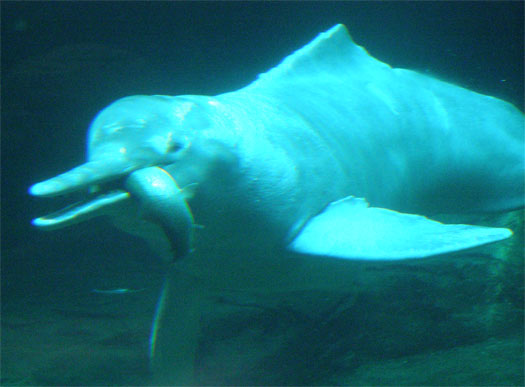
The pink river dolphins’ diet consists mainly of crustaceans, catfish and small fish. They have a unique characteristic in the shape of their unfused vertebrae in their neck which allows them to turn their heads 180 degrees. This characteristic gives them greater flexibility when looking for food and swimming in shallow waters.

mottled river dophin

Dolphins are well known for their intelligence but the intelligence level of the pink river dolphin is not well known. Physically, the ratio of brain mass to body weight compares in such a way which would suggest that they’re very similar to the bottlenose dolphin, which is known for its intelligence. This species are especially known for their almost friendly, curious nature and they are able to quickly learn to associate man with fun, danger or other traits.

river dolphin splashing

Calves are born between June and July usually. When born they’re approximately 30 inches (75 cm) long and weigh just over 22 lbs (1 kg). The gestation period prior to their both is somewhere between nine and twelve months although we don’t have an exact figure. The dolphins sexual maturity is determined by size rather than age, when females are around 5.5 ft (1.7 m) long and the males are around 7 ft (2 m) long they are said to be sexually mature.


Axolotl - Mexican Mudkip, Never Grows Up

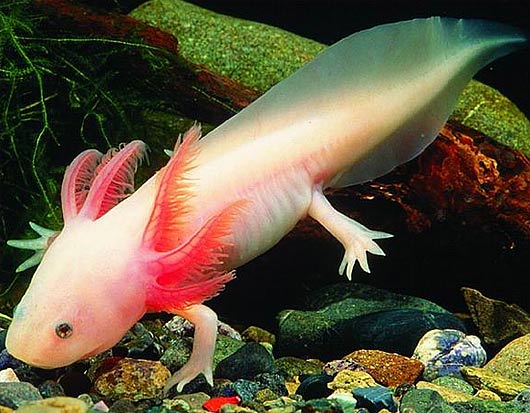
pretty axolotl

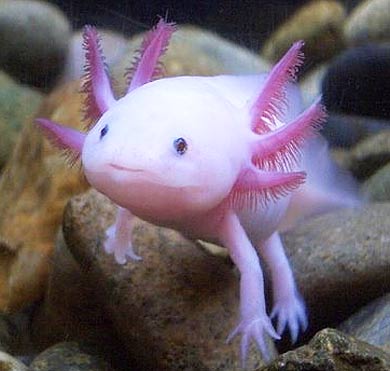
The axolotl is a curious creature native to Mexico. It is best known in its cartoon form as a “Mudkip” in the Pokemon series. It is a type of salamander that does not complete its development in the adult phase – it stays a larva and never grows up. Thus, the gills remain and the axolotl is 100% aquatic, despite the small legs it has.
Adult axolotls range in size from 15 cm (5.85 in) to 45 cm (17.5 in) long and have a wide variety of colors, including grey, shades of brown, yellow and red. They also have harlequin mixtures of colors and patterns. They look like very large tadpoles, with legs and prominent gills. Female axolotls have wider bodies than males, and males have swollen clocae (multi-purpose posterior opening). They use their external gills to extract oxygen from water, but can also gulp air from the surface, using buccal pumping - opening and closing the bottom part of the mouth.

dark axolotl

Shrinking Habitat

The axolotl's natural habitat has always been restricted to two lakes in Mexico: Lake Chalco and Lake Xochimilco. Lake Chalco was drained to prevent annual flooding, so the species has been confined to the Xochimilco lake district, which has become a series of canals, more than a real lake.
Their wild habitat has been shrinking in recent years, due to pollution and the introduction of carp and other non-indigenous fish into the lake. These fish feed on the axolotl young and on the eggs. The Xochimilco lake and its surrounding wetlands are used for the supply of water to Mexico City, and the city's increasing size is putting a strain on the species. There are as few as 700 to 1,200 individual Axolotls alive in the lake, located in six separate regions.
Axolotls used to be sold in Mexico City food markets and were a staple food of the Aztecs.

white friendly axolotl

Doing Science Keeps Axolotls Alive

It is due to their value in scientific research, that the axolotls are almost guaranteed to survive as species, despite their natural habitat destruction. It is probably to do with them being neutenic - that they are able to regenerate and heal so effectively. Whole limbs can be cut off, which then grow back, and are 100% as good as the original. Their healing abilities and large, robust embryos, make them valuable scientific research tools.
They are also popular as pets, since they breed well in captivity and do not need dry land like other salamanders do. It is possible to artificially force metamorphosis in the axolotl, so that it does reach adulthood and then it will live on land. However this is a difficult process and in practice has shortened their lifespan from 15 years, to just 5 years.

Caracal - Precision Black Ears, Bird Hunter

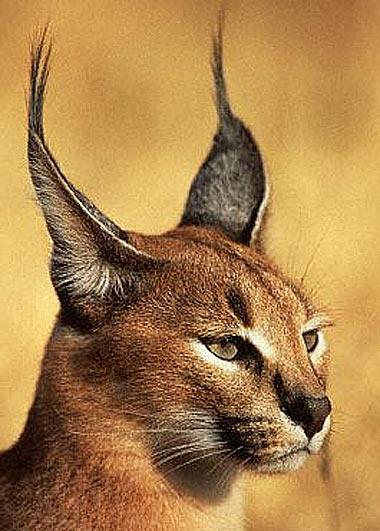
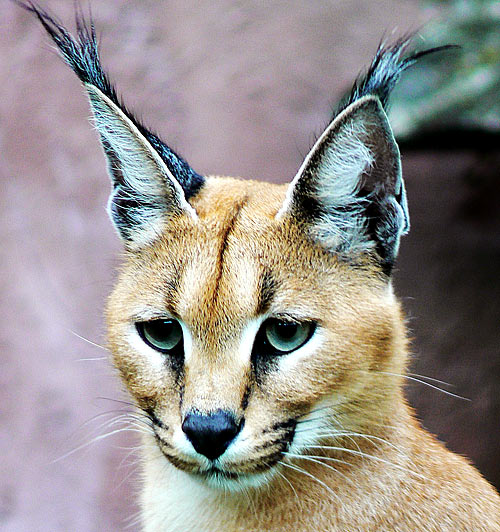
caracal ears 
Once considered to be a type of lynx (hence its formerly being known as a Persian Lynx, an Egyptian Lynx, or an African Lynx), the extremely territorial caracal is actually a small cat, with a length of 26 to 35 inches (65 to 90 centimeters) and a weight of 29 to 40 lbs (13 to 18 kg). The caracal's fur ranges from red-grey to sandy to black, and its look is very distinctive thanks to its elongated, tufted black ears (in fact, its name is derived from the Turkish word 'karakulak', which means 'black ears'). The elongatedears aren't just for show though, as they are controlled by 29 different muscles, and are used to locate prey. It can also be distinguished by its eyes, which contract to small circles, rather than slits like most cats.
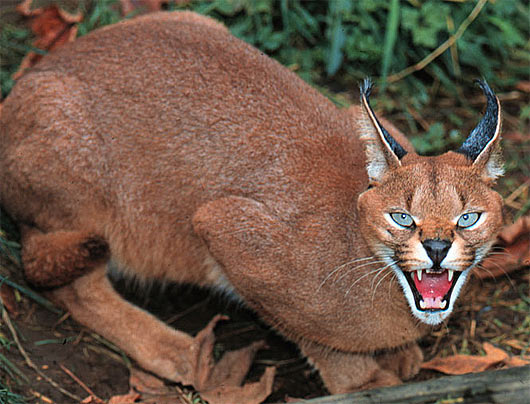
                                                                       Caracal says "Go Away!"
says get away


close upThe caracal can be found in the dry steppes, woodlands, savannahs, scrub forests. and semi-deserts of Africa, the Middle East, Pakistan, and India. Basically, the caracal is okay living anywhere that contains cover sufficient enough for ambushing prey. Due to its getting  a lot of its fluid intake from its prey, they can go long periods of time without water. The caracal's main prey is birds, of which they are known to be able to snatch out of mid air using a variety of pouncing techniques and its athleticism. Thecaracal is also known to hunt larger prey, and to cover up a carcass if they can't finish it (there's even been reports of caracal hiding dead prey in trees).


prey

Caracals are fairly solitary animals, preferring to dwell either alone or in groups of two. When they do encounter other members of their species, they can growl, hiss, purr, and bark as means of communication. The species currently isn't in any danger of extinction, and since they're used as hunting companions in some places (they're somehow easy to train/domesticate), their species will most likely stay strong.

says hey

Tuesday, 2 April 2013


Giant Golden-crowned Flying Fox, Fruit Bat, World's Largest Bat, Endangered


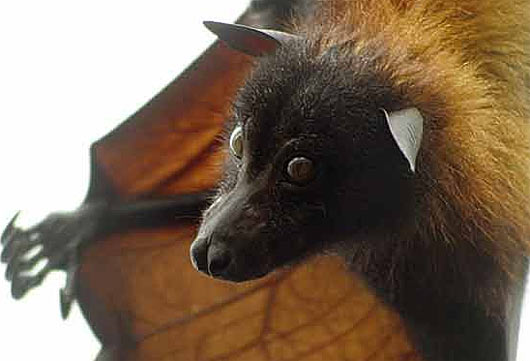
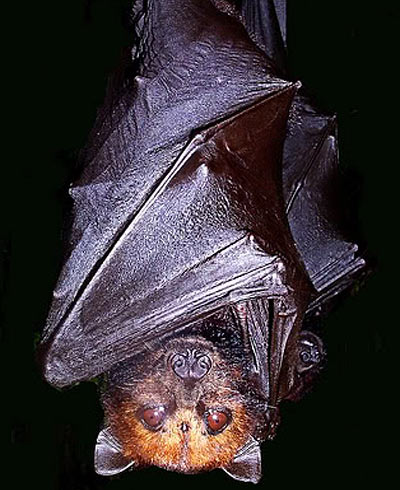
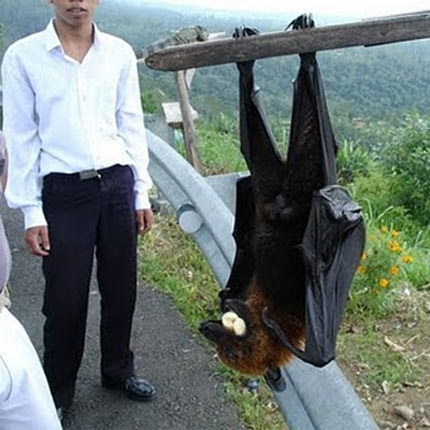
golden crowned giant flying fox headThe Giant golden-crowned flying fox, or as it's sometimes known, the golden-cappedfruit bat, is the largest known species of bat in the world. Getting its name from the golden fur that sits around its head, and its 5 ft (1.5 meter) wingspan; the giant golden-crowned flying fox has no tail and weighs up to 2.6 lbs (1.2 kg). It inhabits the Philippine islands of Bohol, Boracay, Cebu, Leyte, Luzon, Mindanao, Mindoro, Negros and Polillo, and is confined mainly to their rainforests at elevations ranging from sealevel, all the way to 3,600 ft  (1.1 km).

golden crowned giant fruit bat 
Preferring to stay almost exclusively in untouched areas of forest, human intrusion into the rainforest, as well as poaching (they're hunted for their meat and pelts) has caused the giant golden-crowned flying fox to reach a population level low enough that extinction of the species is feared.

large specimen flying fox

A primarily nocturnal creature (as are most bats), it can travel at least 25 miles (40 km) per night while searching for food – mostly figs but also regional fruits like puhutan, lamio, bankal, tangisang, bayawak and strangler figs. Referred to as “The Silent Planter”, giant golden-crowned flying-foxes are known to scatter the seeds of the fruit they eat in their dropping; this makes them vital to the ecosystem of the Philippines' rainforests. Prior to the thinning of their species, giant golden-crowned flying-foxes were known to make colonies with another large bat species (Malayan Flying Foxes). These colonies, meant to help them keep warm and avoid predators, actually ended up making them easier to hunt, and aided in their ascent into near extinction. Due to their vitality to their ecosystem, it's important that efforts are made to conserve the impressive species that is the giant golden-crowned flying fox.

giant fruit bat flying

White Orca, Rare Albino Killer Whale


White Orca, Rare Albino Killer Whale

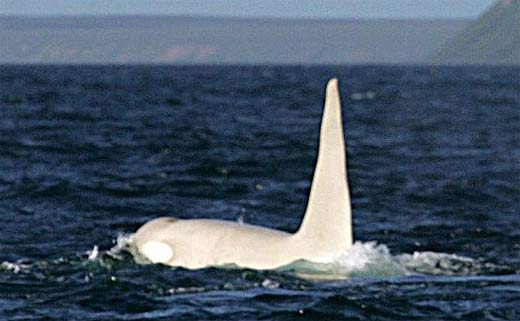
white orca whaleIn what is believed to be an unprecenedented occurence, scientists doing research off the coast of Russia believe that they have spotted the rare white orca or killer whale. There has never been a recorded sighting of a full grown adult white orca in the history of the world; since the are believed to die very young. White orcas are albino, which is a genetic anomaly and therefore leaves them with weakened immune systems. While there have been numerous sightings of baby white orcas, these specimens aren't believed to ever reach maturity. In order to determine whether the specimen, who they've nicknamed "Iceberg", is actually albino, scientists hope to photograph his eyes and find out if they're the tell-tale color, pink. If Iceberg proves to be the real deal, his apparent age of 16 (they're gathered that from the size of his dorsal fin) will surely make him the oldest specimen that anyone has ever come in contact with. He seems to fit right in with a nice-looking group of orcas. We wonder if he has ever made friends with any all-white beluga whales.
big albino orca whale